J. Holland's Typological Theory
J. Holland's Typological Theory
John Holland first introduced his theory in 1959, and it belongs to the so-called Psychodynamic theories. The main assumption of these theories is that individuals develop specific needs and/or motivations based on the structure of their personality. Therefore, each individual chooses a specific career in order to satisfy these needs and/or motivations, which are shaped by their distinct personality type (Freud, Adler, Roe, Hoppock).
This theory also belongs to the Person–Environment Fit Model. According to John Holland, when an individual is required to make career choices, they attempt to match their personal characteristics with a psychologically suitable environment.
The goal is to predict the degree of agreement – fit between the individual and the environment.
Basic Principles:
- Choosing a profession is an expression of personality, motivations, needs, knowledge, and abilities.
- People who belong to a specific professional environment tend to have similar personalities and characteristics.
- The response of a particular professional group is similar when facing various situations and problems.
- Professional satisfaction, stability, and success depend on the degree of agreement between the individual’s personality and the professional environment.
Basic Assumptions
The core of John Holland's theory is based on certain assumptions, which are as follows:
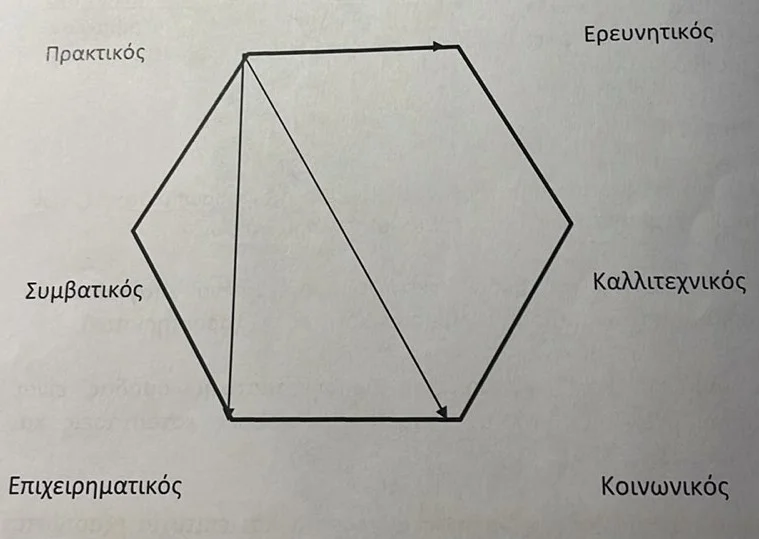
- An individual’s personality is categorized into six types. These types are Realistic, Investigative, Artistic, Social, Enterprising, and Conventional (RIASEC).
- There are correspondingly six categories of work environments: realistic, investigative, artistic, social, enterprising, and conventional. Each of these categories corresponds to a personality type.
- Individuals show a preference for environments that “support” the expression of their personality and the activation of their abilities.
- Final behavior is determined by the interaction between personality traits and the environment.
John Holland developed the following hexagonal model, which illustrates the relationships between personality types and work environments: